ET25SWE0024 - Residential Multi-function Heat Pump Market Study
Air source heat pumps for space conditioning and water heating are keystone technologies in efforts to decarbonize buildings.[1] Heat pumps have the potential to save approximately 60% of total residential heating energy consumption and reduce GHG emissions by 13.1 MMTCO2e if installed in homes throughout California.[2] However, home electrification with traditional heat pumps will require electrical panel upgrades in an estimated 30[3] to 50 percent (or more) of homes[4], adding to the cost and time required to retrofit with heat pumps.
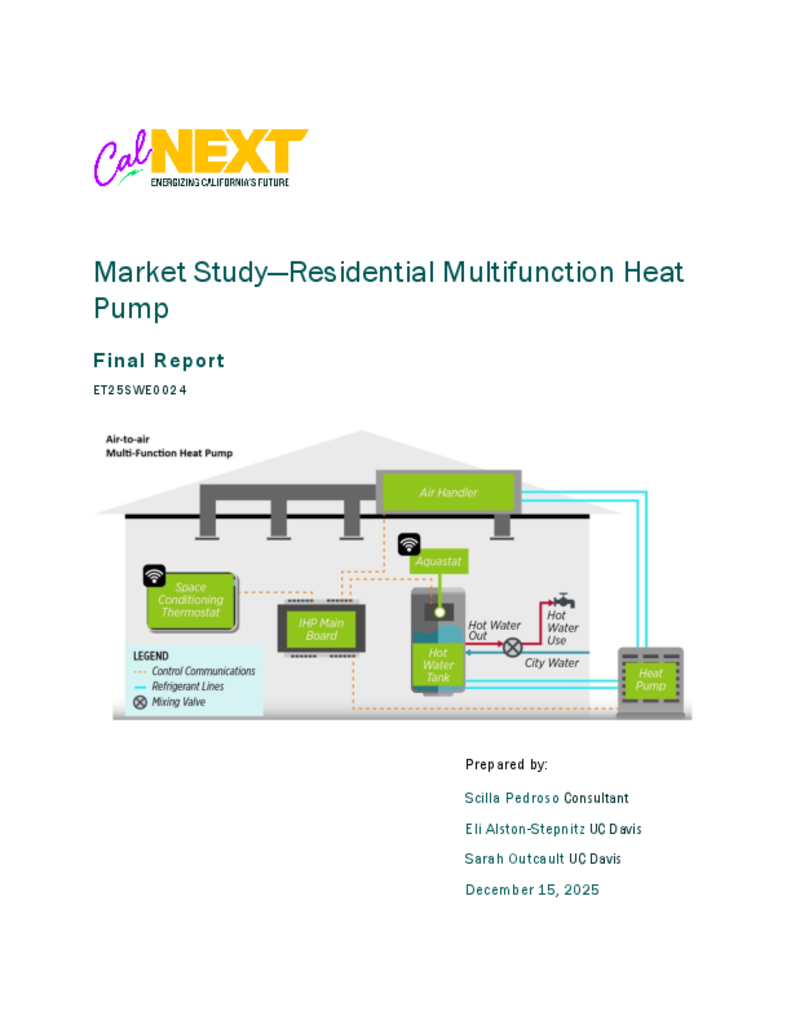
By contrast, residential air-to-air multi-function heat pumps (MFHPs) utilize a single efficient compressor and outdoor heat exchanger coil to provide space cooling, heating, and domestic hot water. These systems can save energy compared to standard gas-fired or electric heating, ventilation, and air conditioning (HVAC) systems, as well as traditional water heating equipment. MFHPs may also offer greater energy savings than separate HVAC and hot water heating units by eliminating the need for electric-resistance backup heaters. This reduces the overall maximum power requirements and, in many retrofit cases, allows full-capacity systems to fit into existing electrical panels. MFHPs transfer thermal energy into and out of the building using refrigerant and can also recover waste heat from cooling to provide additional hot water, further enhancing energy savings.
The residential MFHP market is in its infancy in California. While only one product - offered by a California company - is commercially available in California, several foreign manufacturers (Panasonic, LG, Samsung) have imminent plans to market their residential MFHP products in the state, according to information gathered by WCEC researchers from a multitude of sources (e.g., product expos, web searches, direct outreach to manufacturers). The proposed project will support continued efforts to maintain up-to-date information on residential MFHPs entering the California market. In addition, to support the rapid deployment of this technology, this study will examine the factors that will influence and pose barriers to market adoption of residential MFHPs; characterize the target market; and consider the implications for how efficiency programs should target potential customers. To meet these objectives, the study will analyze data collected from existing reports and subject matter experts (e.g., program managers, policymakers, manufacturers, installers, and researchers). Taking a holistic approach, the study will consider how programs might address the technical, economic, policy, workforce, and customer-related factors that will influence the adoption of MFHPs. The study will also explore the unique challenges associated with MFHP adoption among underserved communities.
MFHPs merit significant attention and resources to support their adoption given their potential to save energy and facilitate electrification without electrical panel upgrades. The study aims to support the adoption of residential MFHPs by identifying market barriers to adoption and opportunities for efficiency programs to address them.
[1] Gaur, A. S., Fitiwi, D. Z., & Curtis, J. (2021). Heat pumps and our low-carbon future: A comprehensive review. Energy Research & Social Science, 71, 101764
[2] Applying a 50% emission reduction (Brockway & Delforge, 2018) to the estimated 1.8 MTCO2e per California household (CARB GHG Emissions Inventory, 2021).
[3] Efficiency First California, 2020; Murphy, 2022; Zhao, 2021; Lindsey, 2023
[4] Merski, C. (2021). Addressing an Electrification Roadblock: Residential Electric Panel Capacity. Austin, Texas: Pecan Street. Retrieved from https://www.pecanstreet.org/2021/08/panelsize/
Residential buildings account for a substantial share of California’s greenhouse gas emissions, underscoring the urgent need for efficient and scalable electrification solutions for space heating, cooling, and water heating. Residential air-to-air multifunction heat pumps (MFHPs) offer a potential pathway by integrating these services into a single system.
The research applies a mixed-methods approach to identify key market barriers and opportunities for residential MFHPs, combining: (1) a landscape analysis of technical, policy, and market conditions; (2) interviews with 49 stakeholders representing 41 organizations; and (3) a representative survey of 961 California homeowners. Synthesizing insights across these efforts, the study characterizes MFHP technology attributes, technical performance, cost-effectiveness, market readiness, and perceptions among both trade allies and household decision-makers.
Findings indicate that MFHPs can provide space conditioning and domestic hot water using a single compressor at substantially lower amperage than conventional configurations with separate heat pump systems, improving retrofit feasibility and reducing the likelihood of electrical panel upgrades. Stakeholders and customers identify long-term energy savings, lower utility bills, environmental benefits, and the convenience of integrated service as core value propositions. At the same time, high upfront costs, uncertain performance, perceived reliability concerns, and limited contractor familiarity remain significant barriers to adoption.
To address these challenges, the study recommends establishing a dedicated product classification and performance standard for MFHPs, aligning U.S. testing procedures with international protocols, improving controls and interoperability, and expanding field demonstrations to build evidence on real-world performance and reliability. Additional priorities include targeted incentives that account for avoided panel upgrades and grid benefits, cross-trade workforce development, and support for ultra–low-GWP refrigerants. Taken together, these findings position MFHPs as a promising but early-stage technology that will require coordinated action by manufacturers, utilities, program administrators, and policymakers to validate performance, reduce cost and risk, and define the highest-value applications—particularly in underserved and electrically constrained households