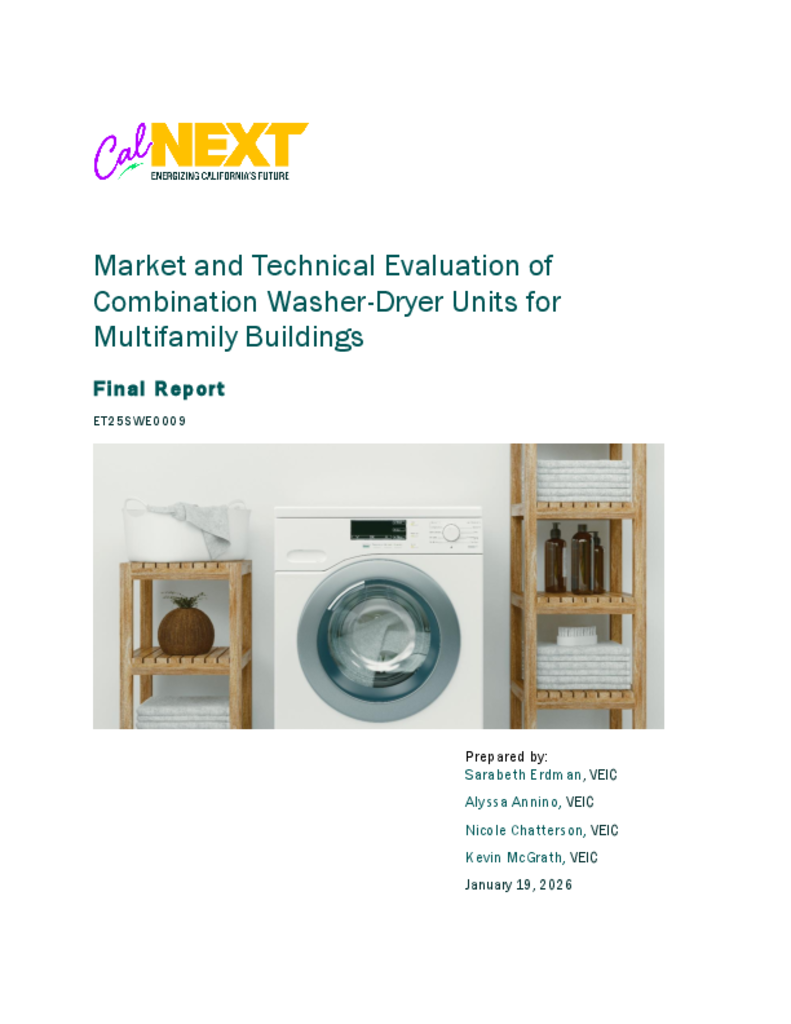
ET25SWE0009 - Market and Technical Evaluation of Combination Washer-Dryer Units for Multifamily Buildings
Laundry remains a significant obstacle to decarbonization efforts of multifamily buildings in California, with limited adoption of high efficiency equipment, especially heat pump clothes dryers. In addition, most LMI households living in multifamily buildings lack in-unit laundry, increasing barriers to equitable access to cost and energy efficient laundry. The recent market entrance of 120V combination washer and heat pump dryers has introduced new opportunities for decarbonizing laundry in multifamily buildings. VEIC will evaluate the potential of combination washer and heat pump dryer units as an option for energy efficient electrification of multifamily housing, while also increasing in-unit laundry access for multifamily residents and reducing reliance on shared laundry facilities and laundromats. The project team will assess the scale of the market opportunity; estimate energy and GHG impacts; evaluate property owner and tenant costs and impacts; and identify space and infrastructure (electrical and mechanical) requirements for transitioning from common area to in-unit laundry.
This project will include a market characterization study, energy and cost modeling, and outreach to stakeholders, including multifamily building residents, owners, and community-based organizations working in disadvantaged communities. The geographic scope of this research will be statewide, with region-specific analyses if data are available. Stakeholder engagement will focus on LMI households and disadvantaged communities. If our research indicates that combination units are a feasible and cost-effective means of electrifying California’s multifamily buildings, future work will consider a pilot project to deploy and track performance of combination units.
Decarbonizing laundry in California’s multifamily housing sector remains challenging due to the dominance of gas‑fired dryers, limited in‑unit laundry access—especially for low‑ to moderate‑income (LMI) households—and low market familiarity with heat pump drying technology. The emergence of 120‑volt combination washer/heat pump dryer units offers a promising pathway to expand in‑unit electric laundry without costly electrical upgrades or venting requirements. This CalNEXT technology support research (TSR) evaluates the technical performance, market potential, and equity implications of deploying these combination units across California’s multifamily building stock.
The analysis shows that 120V combination units deliver meaningful advantages for multifamily applications: standard‑outlet compatibility, ventless operation, compact sizing, and user convenience from all‑in‑one operation. Energy modeling indicates that these units can reduce building‑level energy use when replacing gas or electric resistance dryers, though outcomes vary depending on existing laundry configurations and ownership models. Stakeholder engagement revealed persistent barriers—including low awareness of heat pump drying, concerns about longer drying times, third‑party ownership of shared laundry equipment, and the risk of cost‑shifting to residents when transitioning to in‑unit appliances.
Key outcomes highlight that (1) the technology is technically viable for widespread multifamily deployment, (2) market adoption will remain limited without targeted education and demonstration, and (3) equity impacts hinge on addressing resident energy burden and building‑owner risk. Based on these findings, the report recommends: expanding education and outreach to increase awareness of heat pump drying; providing robust warranties and clear maintenance guidance to reduce ownership hesitancy; designing demonstration projects that test both resident‑owned and building‑owned models; and integrating combination units into California incentive programs by adding them to the Technical Reference Manual.
Together, these actions can accelerate equitable access to efficient electric laundry, reduce reliance on gas‑fired shared facilities, and support California’s broader decarbonization goals.