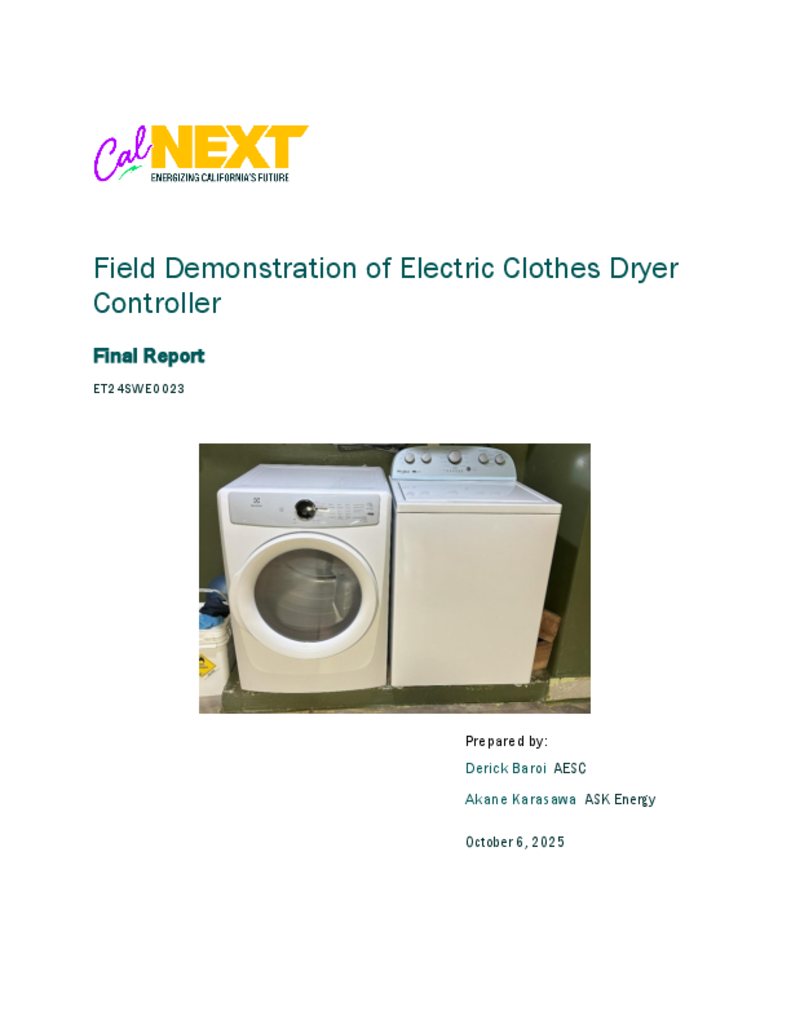
ET24SWE0023 - Field Demonstration of Electric Clothes Dryer Controller
The proposed project is a field demonstration of an electric clothes dryer controller that can be added onto an existing electric dryer. Previous studies have shown that clothes dryers operate longer than needed even in automatic termination mode, wasting energy and drying time. The proposed technology consists of a duct adapter, a temperature and humidity sensor, and a controller and can be installed easily without tampering with existing power or dryer wiring. The sensor in duct detects the temperature and humidity in the dryer exhaust air stream and turns off the dryer when the exhaust air reaches an optimal level of dryness. To our knowledge, this is the only commercially available product that can be added onto existing dryers.
The technology was lab tested using the DOE’s test procedures on four different electric dryer models, which resulted in 15-20% estimated annual energy savings, with savings ranging from 75 to 125 kWh per year. The lab test also found that small energy savings occurred for newer dryer models that employed both thermistors and sensor bars, indicating that the newer dryer models can also benefit from the technology. With this project, the energy saving of the product will be evaluated in fields that is in residential homes. The field testing will supplement the previous lab test with a broader and more comprehensive dataset, allowing us to refine energy savings estimates in real-world applications. Additionally, a survey will be conducted to collect information on user experiences.
Residential electric clothes dryers account for approximately 6 percent of household electricity use in the U.S., yet their efficiency has remained largely unchanged for decades. Over-drying is a common issue, even with automatic termination features, resulting in unnecessary energy consumption and greenhouse gas emissions. Improving dryer efficiency is critical to California’s SB 100 decarbonization goals and offers a cost-effective pathway to reduce residential energy demand.
This study evaluates an add-on controller designed to terminate drying based on exhaust air temperature and humidity, aiming to reduce energy waste. The objectives were to quantify real-world energy savings, assess user satisfaction, and identify adoption barriers for this emerging technology.
The controller was installed in ten homes across California’s Climate Zone 12, including disadvantaged communities. Energy consumption and cycle duration were monitored for three months before and after installation using IPMVP Option A protocols, supplemented by customer surveys for user feedback. Data analysis compared baseline and post-installation performance.
The controller achieved an average 19.4 percent reduction in energy per drying cycle and 15.8 percent shorter drying cycle times, translating to annual savings of 133 to 220 kWh per household and 53 to 88 kg CO₂e emissions reduction. Customer satisfaction was high, with 100 percent reporting adequate dryness and 78 percent noticing shorter cycles. Simple payback ranged from 4.0 to 6.6 years, depending on usage.
Field results confirm that add-on dryer controllers can significantly reduce energy use and support statewide decarbonization goals. Broader adoption through utility incentive programs, particularly in disadvantaged communities, could deliver substantial cumulative savings. Future work should focus on algorithm optimization, expanded testing, and design improvements for plug-and-play installation.