ET22SWE0039 - ASHRAE Guideline 36 Open Source Supervisory Control Technology Development and Demonstration
This project is an open source supervisory control technology development and demonstration of ASHRAE Guideline 36 (G36), ASHRAE 2021.
The promise of G36 is that the standardization of the sequence of operations (SOO) allows manufacturers to program and centrally test the control logic and then distribute to installers. This approach reduces cost and the risk of errors inherent in the current practice. Designers can specify G36 rather than write their own SOO. Installers can draw from a library of G36 control logic options rather than program their own logic. G36 can minimize functional testing, as the logic will be pre-programmed at the factory.
Two buildings have been selected for the study that have supervisory control hardware and software platforms in place. These platforms utilize Control Description Language (CDL) for documenting and implementing control logic. The Brick schema is an open-source effort to standardize descriptions of physical and logical assets in buildings and the relationships between them. CDL and the Brick schema together enable the testing and implementation of ASHRAE G36 standardized sequences of operations. To execute the project plan, we will establish a baseline of HVAC system performance and energy consumption, implement the new control sequences, and then perform measurement and verification to document the expected savings.
Although ASHRAE Guideline 36 was recently released, it has been in development for a number of years. This project builds on ongoing efforts to document the positive impact that implementing G36 can have on existing and new commercial buildings in CA. We have recruited a major contributor to ASHRAE Guideline 36 (Taylor Engineers) as well as leading Brick schema researchers (University of California, Berkeley 's Center for the Built Environment ) to serve on the project team.
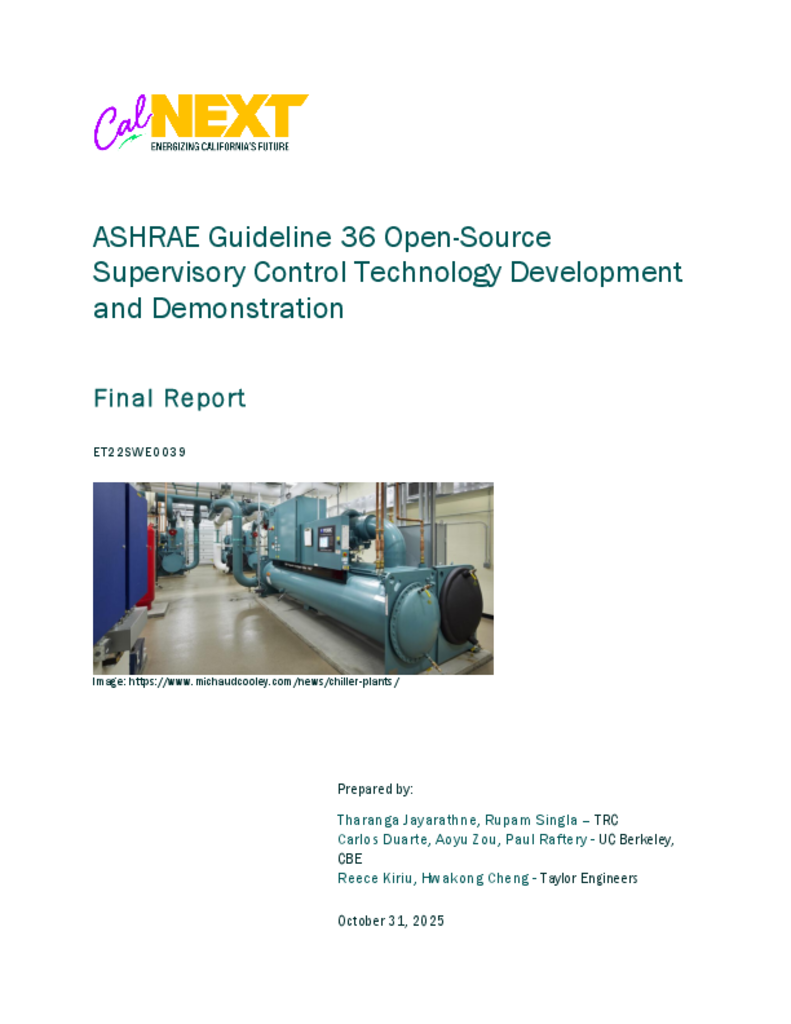
This project demonstrates a scalable approach to implementing ASHRAE Guideline 36 (G36) sequences of operations for chilled water and hot water plants in existing buildings. G36 establishes industry best practices for standardized HVAC control strategies, enabling improved energy efficiency and system performance and previous studies have shown significant energy savings for airside systems. Expanding on this, the research team deployed G36 sequences in one chilled water plant and two hot water plants across two buildings using a layered architecture that integrates supervisory control platforms, Control Description Language programming, and Brick ontology tagging.
The supervisory control layer enabled seamless coordination with existing building automation systems, minimizing infrastructure changes. Control Description Language facilitated transparent and modular implementation aligned with G36 specifications, while Brick ontology tagging created a machine-readable semantic model for scalable integration and diagnostics. Prior to deployment, the team conducted a comprehensive evaluation and retro-commissioning process to correct existing control and equipment issues that could limit performance.
Measurement and verification were performed using metered energy data and regression models with typical meteorological year weather data to determine weather-normalized annual energy consumption. The results demonstrated 7 and 11 percent energy savings in the hot water plants and 15 percent savings in the chilled water plant, translating to annual cost reductions ranging from $0.095 to $0.17 per square foot. This project highlights the potential of modular and scalable G36 adoption to enhance energy efficiency across diverse systems while minimizing engineering effort. It also emphasizes the critical role of retro-commissioning in optimizing system performance and ensuring successful implementation in complex environments.